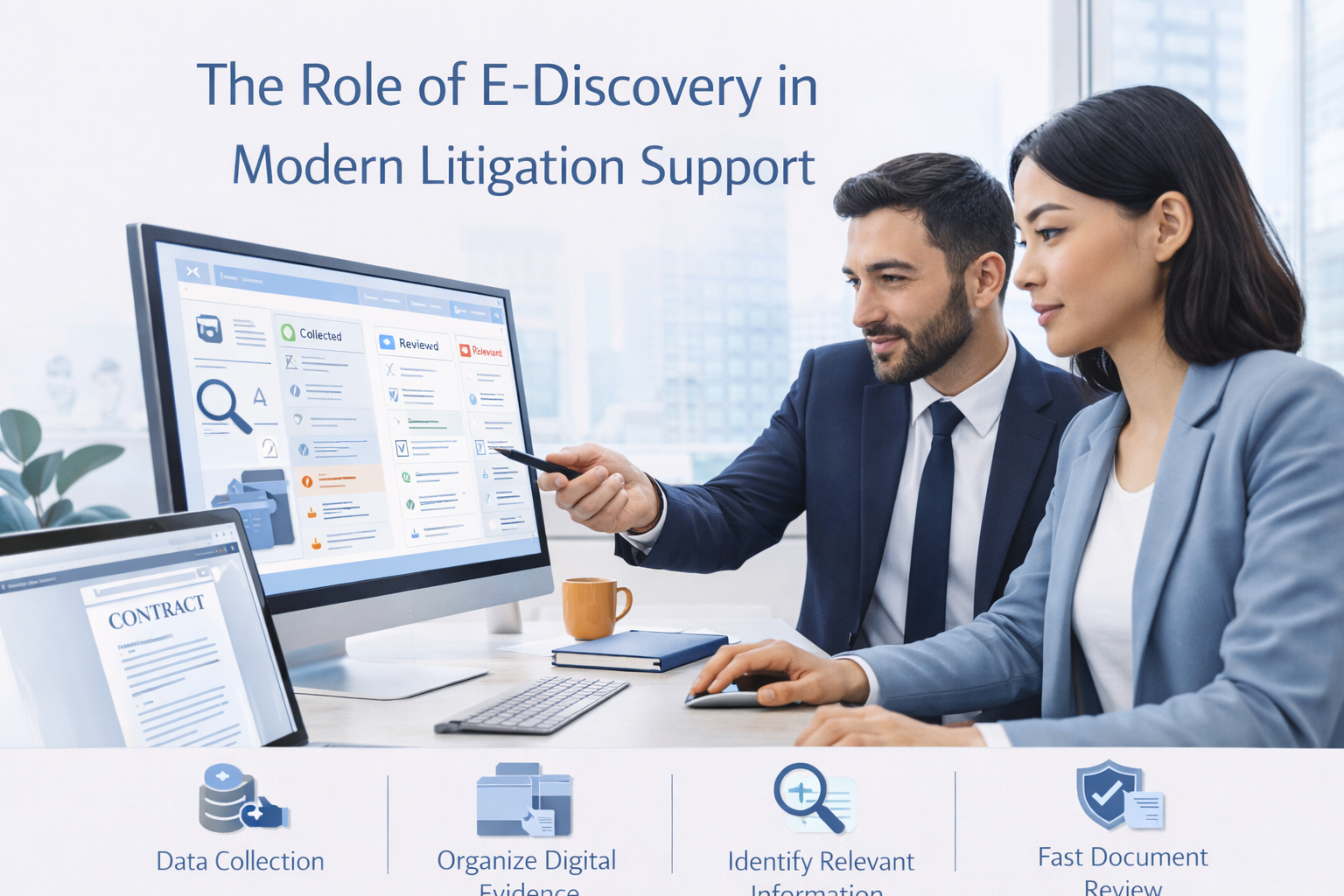
The landscape of litigation has fundamentally transformed over the past two decades. Where attorneys once reviewed boxes of paper documents, todays legal disputes involve terabytes of electronic data emails, text messages, social media posts, cloud storage, metadata, and digital communications that can make or break a case.
E-discovery the process of identifying, collecting, reviewing, and producing electronically stored information (ESI) in legal proceedings has evolved from a specialized niche to an essential component of virtually every litigation matter. Understanding e-discovery’s role in modern litigation support is no longer optional for law firms seeking to effectively represent clients and manage cases efficiently.
What Is E-Discovery?
E-discovery encompasses the entire lifecycle of managing electronic evidence in litigation, arbitration, investigations, and regulatory matters. The process typically follows the Electronic Discovery Reference Model (EDRM), which outlines key phases:
Identification: Locating potential sources of relevant ESI across multiple systems, devices, and platforms.
Preservation: Implementing legal holds to prevent deletion or alteration of potentially relevant data.
Collection: Gathering ESI from identified sources in a forensically sound manner that maintains data integrity.
Processing: Filtering, de-duplicating, and culling data to reduce volume and extract relevant information.
Review: Analyzing documents for relevance, privilege, and responsiveness to discovery requests.
Production: Delivering discoverable materials to opposing parties in appropriate formats with proper metadata.
Presentation: Organizing and presenting evidence effectively for depositions, hearings, and trial.
Each phase requires specialized expertise, technology platforms, and systematic processes to manage effectively which is why e-discovery has become a critical element of litigation support.
Why E-Discovery Matters in Modern Litigation
The volume and complexity of electronic evidence in contemporary cases has made traditional document review methods obsolete. Consider the realities of modern discovery:
Data Volume: A single custodian may have hundreds of thousands of emails, documents, and files. Complex commercial litigation can involve millions of documents across dozens of custodians.
Data Diversity: Evidence now exists in numerous formats emails, attachments, spreadsheets, presentations, databases, social media, instant messages, mobile devices, collaboration platforms, and cloud storage.
Metadata Significance: Beyond document content, metadata (creation dates, modification history, email headers, geolocation data) often provides critical evidence of timing, authorship, and document handling.
Speed Requirements: Modern discovery timelines demand rapid review and production often requiring teams to process and analyze thousands of documents weekly.
Cost Considerations: Manual review of massive data volumes at attorney hourly rates can cost hundreds of thousands or even millions of dollars, making cost-effective e-discovery solutions essential.
Sanctions Risk: Failure to properly preserve, collect, or produce ESI can result in severe sanctions, adverse inferences, or case dismissal.
Effective e-discovery support has become as fundamental to litigation success as legal research and motion practice.
Core Components of E-Discovery Support
Modern litigation support services provide comprehensive e-discovery capabilities that address each phase of the process:
Data Collection and Preservation
Professional e-discovery support begins with implementing litigation holds and collecting data in forensically defensible ways. This includes:
- Coordinating with IT departments and custodians to identify relevant data sources
- Implementing preservation protocols to prevent spoliation
- Collecting data from email servers, file shares, mobile devices, and cloud platforms
- Maintaining chain of custody documentation
- Preserving metadata and maintaining data integrity
Data Processing and Filtering
Raw data collection produces enormous volumes that must be reduced to manageable, relevant subsets:
- De-duplication to eliminate redundant copies
- Email threading to group related communications
- Date filtering to focus on relevant time periods
- Keyword filtering and search term optimization
- File type filtering to exclude system files and irrelevant formats
- Conceptual clustering to identify document families and themes
Document Review and Analysis
The review phase involves analyzing processed documents for relevance, privilege, and strategic significance:
- Responsiveness review to identify discoverable documents
- Privilege review to protect attorney-client communications and work product
- Issue coding to tag documents by legal issue, witness, or chronology
- Hot document identification for key evidence
- Quality control to ensure review consistency and accuracy
- Redaction of confidential or protected information
Production and Presentation
Once review is complete, responsive documents must be produced appropriately:
- Production format negotiation (PDF, native, TIFF)
- Bates numbering and production tracking
- Privilege log preparation
- Load file creation for opposing counsel’s review platform
- Production verification and quality assurance
- Organization of exhibits for depositions and trial
Technology-Assisted Review: The E-Discovery Revolution
Traditional linear review attorneys reading every document sequentially has become economically unsustainable for large-scale discovery. Technology-assisted review (TAR) has transformed e-discovery efficiency:
Predictive Coding: Machine learning algorithms analyze attorney-reviewed documents and predict relevance for remaining unreviewed materials, dramatically reducing review time and cost.
Concept Clustering: AI groups conceptually similar documents together, allowing reviewers to quickly identify document families and make consistent relevance decisions.
Email Threading: Advanced algorithms identify complete email conversations, eliminating redundant review of duplicated email chains.
Advanced Analytics: Data visualization, communication pattern analysis, and timeline construction reveal relationships and evidence patterns that manual review might miss.
These technologies don’t replace attorney judgment they enhance it, allowing legal teams to focus review efforts on the most significant documents while managing massive volumes cost-effectively.
E-Discovery Across Practice Areas
While e-discovery emerged from complex commercial litigation, it now plays critical roles across virtually all practice areas:
Personal Injury: Text messages, social media posts, medical records, and surveillance footage often provide crucial evidence of liability and damages.
Family Law: Emails, financial records, text communications, and social media content frequently become central to custody, support, and asset division disputes.
Employment Litigation: Email communications, personnel files, timekeeping records, and internal messaging platforms document workplace conduct and policy enforcement.
Intellectual Property: Source code, development emails, design documents, and file metadata establish invention dates, authorship, and potential infringement.
White Collar Criminal Defense: Financial records, email communications, and document metadata are essential to investigating alleged fraud, embezzlement, or regulatory violations.
Regulatory Compliance: Government investigations require comprehensive ESI production demonstrating compliance with regulations and industry standards.
No practice area is immune from e-discovery demands in today’s digital environment.
The Cost-Benefit Analysis of E-Discovery Outsourcing
Many law firms face a critical decision: build internal e-discovery capabilities or outsource to specialized providers. The economics strongly favor outsourcing for most firms:
Technology Investment: E-discovery platforms can cost $50,000 to $500,000+ annually, plus implementation and training costs expenses that only make sense for the highest-volume practices.
Specialized Expertise: E-discovery requires technical knowledge of data formats, forensic collection, processing software, and review platforms that generalist staff typically lack.
Scalability: Discovery volumes fluctuate dramatically between matters. Outsourcing provides instant scalability without maintaining excess capacity during slow periods.
Cost Efficiency: Outsourced review teams provide experienced document reviewers at significantly lower rates than using associate attorneys for first-level review.
Risk Management: Professional e-discovery providers maintain quality control processes, defensible methodologies, and documentation that reduce sanctions risk.
Speed: Dedicated e-discovery teams can scale up quickly to meet aggressive production deadlines that would overwhelm in-house staff.
For most firms, outsourcing e-discovery support delivers superior results at lower total cost while allowing attorneys to focus on case strategy rather than data management.
Key Considerations When Selecting E-Discovery Support
Not all e-discovery providers offer equivalent capabilities. When evaluating potential partners, law firms should assess:
Technology Platform: Do they use industry-standard platforms (Relativity, Everlaw, Logikcull) that ensure compatibility and efficiency?
Data Security: What protocols protect sensitive client data? Look for encryption, secure data centers, access controls, and compliance with privacy regulations.
Review Team Expertise: Are reviewers experienced with your practice areas? Do they understand legal concepts, privilege, and the nuances of different case types?
Quality Control: What processes ensure review consistency and accuracy? How are disagreements and edge cases handled?
Project Management: Will you have a dedicated point of contact? How do they handle communication, progress reporting, and deadline management?
Pricing Transparency: Are costs clearly structured? Watch for hidden fees, minimum volumes, or platform access charges.
Flexibility: Can they scale quickly for rush productions? Do they offer various engagement models to match your needs?
Track Record: Can they provide references from law firms with similar practice areas and case types?
Best Practices for Effective E-Discovery
Successful e-discovery requires collaboration between law firms and their support partners:
Early Planning: Discuss e-discovery scope, timelines, and strategy during case assessment not as production deadlines loom.
Clear Communication: Provide detailed review protocols, definitions of relevance, and examples of privileged materials to ensure consistent decision-making.
Iterative Review: Start with sample sets to calibrate review approach before processing full data volumes.
Cost Management: Use processing and filtering strategically to reduce review volumes before engaging expensive attorney review.
Preservation Diligence: Implement litigation holds immediately and document preservation efforts to defend against spoliation claims.
Production Negotiation: Work with opposing counsel on production formats, timing, and scope to avoid unnecessary expenses and disputes.
Technology Leverage: Use TAR and analytics for large-scale matters to dramatically reduce costs while improving review quality.
The Future of E-Discovery
E-discovery continues to evolve rapidly as technology advances:
Artificial Intelligence: Machine learning and natural language processing will increasingly automate relevance determinations and privilege review.
Cloud-Based Platforms: Browser-based review platforms provide instant access and collaboration without software installation.
Mobile and Ephemeral Data: Discovery now encompasses text messages, social media, collaboration platforms, and even disappearing messages.
International Data: Cross-border litigation requires navigating GDPR, data localization requirements, and conflicting privacy regulations.
Real-Time Discovery: Some matters now involve ongoing discovery of streaming data and continuously generated content.
Law firms that partner with e-discovery providers staying current with these developments gain significant competitive advantages in handling complex litigation efficiently.
The Strategic Imperative
E-discovery has evolved from a technical specialty to a core competency for modern litigation practice. The ability to efficiently manage electronic evidence identifying key documents, controlling costs, meeting production deadlines, and avoiding sanctions often determines case outcomes as much as legal arguments.
For most law firms, developing this competency internally is neither practical nor cost-effective. Strategic partnerships with specialized e-discovery support providers deliver the technology, expertise, and scalability needed to handle discovery demands while allowing attorneys to focus on legal strategy and client advocacy.
In an environment where discovery can make or break cases and where mishandling ESI can result in devastating sanctions professional e-discovery support has become essential infrastructure for competitive litigation practice.
Need comprehensive e-discovery and litigation support? FourFold LPO provides end-to-end discovery services including document review, data processing, privilege review, and production support across all practice areas. Our experienced legal professionals and advanced technology platforms help law firms manage discovery efficiently, control costs, and meet aggressive deadlines while maintaining the highest quality standards. Contact us today to discuss how our litigation support services can strengthen your practice and improve case outcomes.
Leave a Reply