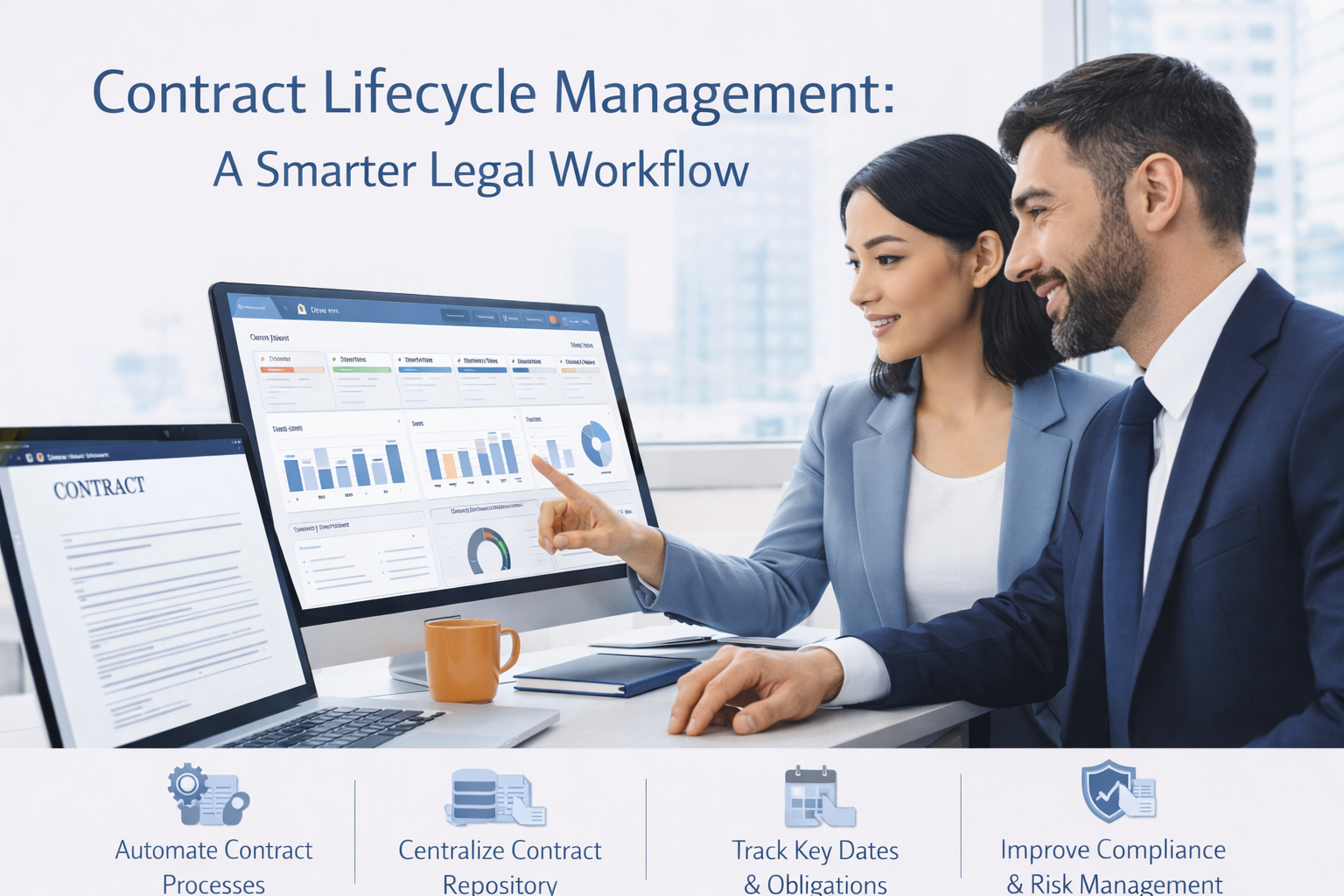
Contracts are the foundation of business relationships governing partnerships, protecting interests, defining obligations, and mitigating risk. Yet for many law firms and businesses, contract management remains one of the most frustrating and inefficient operational challenges.
The symptoms are familiar: contracts lost in email threads, version control chaos, missed renewal deadlines, inconsistent clause language, hours spent searching for executed agreements, and the nagging uncertainty about what obligations are actually in effect.
It’s not a personnel problem. It’s a process problem.
Traditional contract management relying on manual tracking, scattered file storage, and reactive responses to deadlines simply can’t keep pace with the volume and complexity of modern business agreements. The result? Unnecessary risk, wasted time, missed opportunities, and contracts that create more friction than value.
Contract Lifecycle Management (CLM) offers a fundamentally different approach: a systematic, technology-enabled framework that manages contracts from initial request through execution, compliance monitoring, renewal, and eventual termination ensuring visibility, consistency, and strategic control at every stage.
For organizations serious about operational excellence, CLM isn’t just a better way to handle contracts. It’s a competitive necessity.
The Hidden Cost of Manual Contract Management
Before exploring what effective CLM looks like, let’s be honest about what happens without it.
The typical manual contract workflow:
- Someone requests a contract (often via email or verbal request)
- Legal drafts from scratch or searches for a similar previous agreement
- Multiple rounds of internal review and revision
- Counterparty negotiation through email attachments (Version_Final_v3_FINAL_Really.docx)
- Execution via wet signatures, digital signatures, or some combination
- Filing in a shared drive, filing cabinet, or inbox folder
- Hope that someone remembers renewal dates, compliance obligations, or termination windows
The predictable failures:
- Lost visibility: Nobody knows what contracts exist, what terms were agreed to, or where documents are stored
- Version control disasters: Multiple people editing different versions, with no clear record of what was actually executed
- Missed deadlines: Auto-renewal clauses trigger, termination windows close, compliance obligations go unmet
- Inconsistent terms: Each agreement reinvents the wheel, creating unnecessary legal exposure and negotiation complexity
- Slow turnaround: Simple contracts take weeks because every document starts from scratch
- Duplicated effort: Teams waste time searching for templates, recreating clauses, and reformatting documents
- Audit nightmares: When regulators, auditors, or litigators request contracts, the scramble begins
- Strategic blindness: Leadership can’t answer basic questions about contractual obligations, exposure, or opportunities
The cost isn’t just inefficiency it’s risk. Missed termination windows cost money. Untracked compliance obligations create liability. Lost contracts undermine negotiations.
Organizations operating without effective CLM are gambling that nothing important will slip through the cracks. It’s not a question of if, but when.
What Contract Lifecycle Management Actually Means
Contract Lifecycle Management is the systematic approach to managing contracts through their entire lifecycle from initial request and drafting, through negotiation and execution, to ongoing compliance monitoring, renewal management, and eventual termination.
Effective CLM combines three critical elements:
1. Standardized Processes
Clear workflows that define how contracts move through each stage, who is responsible for what, and how approvals are documented. No more confusion about “who’s handling this?” or “what’s the status?”
2. Technology Infrastructure
Centralized contract repositories, automated workflows, template libraries, version control, and reporting dashboards that provide visibility and eliminate manual tracking.
3. Specialized Expertise
Trained legal professionals who understand contract drafting, risk assessment, clause analysis, and compliance monitoring whether in-house or through strategic outsourcing.
When these three elements work together, contract management transforms from reactive firefighting to proactive strategic control.
The Contract Lifecycle: Stage by Stage
Let’s walk through what best-practice CLM looks like at each stage of the contract lifecycle.
Stage 1: Contract Request and Intake
Traditional approach: Someone emails legal asking for “a contract.” Legal spends time clarifying what’s actually needed, gathering basic information, and determining urgency.
CLM approach: Standardized intake forms capture essential information upfront—contract type, parties involved, key terms, business justification, timeline. Requests route automatically to the appropriate legal resource based on contract category and complexity.
Value: Faster response, complete information from the start, proper prioritization, and clear tracking of all requests.
Stage 2: Contract Drafting and Assembly
Traditional approach: Attorney starts with a blank document or searches email/shared drives for a similar previous contract. Recreates standard clauses. Reformats. Hours invested in work that’s been done dozens of times before.
CLM approach: Approved templates with pre-negotiated clauses and variable fields. Standard agreements can be assembled in minutes instead of hours. Custom agreements start from the closest template with proven language. Clause libraries ensure consistency and reduce risk.
Value: 60-80% time savings on standard contracts. Consistent language across all agreements. Reduced legal exposure from ad-hoc drafting.
Stage 3: Internal Review and Approval
Traditional approach: Draft circulates via email to stakeholders. Feedback comes in different formats. Multiple versions proliferate. Consolidating comments and tracking approvals becomes a project unto itself.
CLM approach: Automated routing sends contracts to appropriate reviewers based on type, value, and risk level. All comments tracked in one system. Clear approval workflow with documented sign-offs. Version history maintained automatically.
Value: Faster approval cycles. Clear accountability. No more version confusion. Complete audit trail.
Stage 4: Negotiation and Redlining
Traditional approach: Redlined versions exchanged via email. Legal counsel manually tracks changes, compares versions, manages negotiation history across email threads.
CLM approach: Centralized negotiation workspace with version comparison tools. All redlines and comments tracked. Negotiation history visible at a glance. Fallback positions and approved alternatives documented.
Value: Faster negotiations. Clear visibility into what changed and why. Reduced risk of accepting unfavourable terms inadvertently.
Stage 5: Execution and Storage
Traditional approach: Printed contracts signed via wet signature, scanned, saved to various locations. Or emailed for e-signature with executed copies filed in multiple places. Nobody quite sure which version is “final executed.”
CLM approach: Integrated e-signature workflow. Executed contracts automatically stored in centralized repository with metadata (parties, effective date, contract type, key terms). One authoritative source for all executed agreements.
Value: No more searching for signed contracts. Instant access for authorized users. Clear record of what was actually executed.
Stage 6: Obligation Management and Compliance
Traditional approach: Hope someone remembers that deliverables are due, insurance certificates need updating, or compliance reports must be submitted. Obligations tracked in individual calendars (if at all).
CLM approach: Key obligations extracted and tracked in contract management system. Automated alerts for upcoming deadlines. Compliance checklists tied to contract terms. Dashboard visibility into all open obligations.
Value: No missed deadlines. Proactive compliance management. Reduced liability from unfulfilled obligations.
Stage 7: Performance Monitoring and Amendments
Traditional approach: Contract sits in a file. Performance issues arise. Amendments negotiated reactively. No systematic tracking of contract modifications.
CLM approach: Performance metrics tracked against contract terms. Issues flagged proactively. Amendment process follows same workflow as original contract. All modifications linked to parent agreement.
Value: Early identification of performance issues. Complete history of contract evolution. Strategic leverage in renegotiations.
Stage 8: Renewal and Termination
Traditional approach: Auto-renewal clauses trigger without decision-maker awareness. Termination windows close before anyone realizes. Scrambling to handle contracts that should have been reviewed months earlier.
CLM approach: Automated alerts for upcoming renewals and termination windows (60, 90, 120 days in advance). Decision workflows route to appropriate stakeholders with sufficient time for strategic evaluation.
Value: Intentional decisions about renewals vs. terminations. Ability to renegotiate terms before auto-renewal. No more unwanted contract extensions.
The Technology Foundation: CLM Platforms and Integration
Effective CLM requires the right technology infrastructure. Modern contract management platforms provide:
Centralized Contract Repository
Single source of truth for all contracts with powerful search functionality find any contract instantly by party, date, contract type, value, or custom metadata.
Template and Clause Libraries
Pre-approved templates for common contract types. Reusable clause libraries with alternative language options. Intelligent assembly tools that build contracts based on user inputs.
Automated Workflow Engine
Configurable workflows that route contracts through review, approval, negotiation, and execution based on business rules. Automated escalation for delayed approvals.
Version Control and Audit Trail
Complete history of every change, who made it, and when. Compare any two versions instantly. Document every approval and decision.
E-Signature Integration
Seamless integration with DocuSign, Adobe Sign, or other e-signature platforms. Executed contracts automatically filed in repository.
Obligation and Deadline Tracking
Extract key dates and obligations from contracts. Automated alerts and reminders. Dashboard view of all upcoming deadlines.
Reporting and Analytics
Real-time visibility into contract portfolio how many contracts by type, value, status. Cycle time metrics. Performance tracking. Risk analysis.
Integration with Business Systems
Connect with CRM, ERP, financial systems, and practice management platforms. Data flows automatically between systems.
The Human Element: Where Expertise Matters
Technology provides the infrastructure, but contract management still requires human expertise particularly for complex agreements, risk assessment, and strategic negotiations.
This is where the CLM outsourcing model delivers exceptional value: combining technology platforms with trained legal professionals who handle the substantive work.
What CLM outsourcing teams provide:
Contract Drafting and Assembly
Using approved templates and clause libraries, experienced paralegals and legal assistants draft contracts tailored to specific business needs faster and more cost-effectively than attorney-level resources.
Contract Review and Analysis
Systematic review of incoming contracts against approval criteria and risk parameters. Issues flagged for attorney review. Low-risk agreements approved expeditiously.
Redlining and Negotiation Support
Detailed redlining based on approved positions and fallback language. Tracking of negotiation history. Escalation of substantive issues to attorneys while handling administrative aspects.
Abstraction and Data Entry
Extracting key terms, dates, obligations, and metadata from contracts for entry into CLM systems. Ensuring searchability and reporting accuracy.
Compliance Monitoring
Tracking ongoing contractual obligations, managing compliance checklists, sending reminders for upcoming deadlines, coordinating deliverable submissions.
Renewal Management
Proactive outreach in advance of renewal dates. Routing renewal decisions to appropriate stakeholders. Coordinating renegotiation or termination as directed.
Repository Management
Organizing historical contracts, performing data cleanup, ensuring consistent metadata, maintaining system integrity and usability.
Real-World Applications Across Industries
Effective CLM isn’t industry-specific it’s essential across every sector that relies on contracts. Here’s how different organizations benefit:
Law Firms
Managing client engagement letters, vendor contracts, employment agreements, and office leases. Ensuring conflict checks, rate confirmations, and scope definitions are properly documented. Tracking outside counsel guidelines for corporate clients.
Real Estate Companies
Managing purchase agreements, lease contracts, property management agreements, construction contracts, and vendor relationships. Tracking rent escalations, renewal options, maintenance obligations, and insurance requirements.
Healthcare Organizations
Managing payer contracts, vendor agreements, physician employment contracts, and service agreements. Ensuring HIPAA compliance, credentialing requirements, and rate table accuracy.
Financial Services
Managing client agreements, vendor contracts, partnership agreements, and regulatory compliance documentation. Tracking fee schedules, service level agreements, and termination provisions.
Technology Companies
Managing software licenses, SaaS agreements, partnership contracts, and vendor relationships. Tracking subscription renewals, usage rights, data provisions, and liability limitations.
Manufacturing and Distribution
Managing supplier agreements, distribution contracts, equipment leases, and customer contracts. Tracking pricing terms, volume commitments, quality standards, and delivery obligations.
The Business Case: Quantifiable CLM Benefits
Organizations that implement effective CLM see measurable improvements across multiple dimensions:
1. Time Savings (40-70% reduction in contract processing time)
Standard contracts assembled in minutes instead of hours. Fewer review cycles due to template standardization. Faster approvals through automated routing.
2. Cost Reduction (30-50% lower contract management costs)
Less attorney time spent on routine agreements. Reduced outside counsel costs. Lower administrative overhead through automation.
3. Risk Mitigation (60-80% reduction in missed deadlines)
No more surprise auto-renewals. Compliance obligations tracked systematically. Early warning of expiring agreements.
4. Revenue Protection (5-15% improvement in contract value capture)
Favorable terms preserved through consistent language. Renewal opportunities identified early. Pricing and rate escalations properly enforced.
5. Operational Efficiency (50-70% faster contract cycle times)
From request to execution in days instead of weeks. Bottlenecks identified and resolved. Resources allocated based on actual workload.
6. Strategic Visibility (Real-time portfolio insights)
Executive dashboards showing contract exposure, obligations, and opportunities. Data-driven decisions about vendor consolidation, rate negotiations, and relationship management.
Implementation Roadmap: Getting Started with CLM
Implementing effective CLM doesn’t require a massive, disruptive overhaul. The most successful approaches follow a phased implementation:
Phase 1: Assessment and Planning (Weeks 1-4)
Activities:
- Inventory current contract types and volumes
- Map existing contract workflows and identify pain points
- Define CLM requirements and success metrics
- Select technology platform (if not already in place)
- Determine build vs. buy vs. outsource strategy
Deliverables:
- Current state assessment
- CLM implementation plan
- Technology selection decision
- Resource allocation plan
Phase 2: Foundation Building (Weeks 5-12)
Activities:
- Configure CLM platform or repository
- Develop contract templates and clause libraries
- Design approval workflows and routing rules
- Establish metadata standards and taxonomy
- Train core team on new processes
Deliverables:
- Functioning CLM platform
- Template library (top 5-10 contract types)
- Documented workflows
- User training materials
Phase 3: Pilot Launch (Weeks 13-20)
Activities:
- Roll out CLM for one contract type or business unit
- Process new contracts through CLM workflow
- Monitor performance and gather user feedback
- Refine templates, workflows, and processes
- Begin migrating legacy contracts to repository
Deliverables:
- Proven CLM workflow for pilot scope
- Refined templates and processes
- User adoption metrics
- Lessons learned documentation
Phase 4: Expansion and Optimization (Weeks 21-36)
Activities:
- Expand CLM to additional contract types
- Complete legacy contract migration
- Implement advanced features (obligation tracking, analytics)
- Integrate with other business systems
- Establish ongoing training and support
Deliverables:
- Enterprise-wide CLM deployment
- Complete contract repository
- Integrated technology ecosystem
- Sustainable operating model
Phase 5: Continuous Improvement (Ongoing)
Activities:
- Monitor performance metrics
- Optimize templates and workflows based on data
- Expand clause library and automation
- Stay current with technology updates
- Regular training refreshers
Deliverables:
- Quarterly performance reports
- Continuous process improvements
- Updated training materials
- ROI documentation
The Outsourcing Advantage: CLM Without the Overhead
One of the most strategic decisions in CLM implementation is whether to build internal capacity or partner with specialized outsourcing providers.
The outsourcing model offers distinct advantages:
Faster Implementation
No hiring delays, training curves, or learning from scratch. Outsourcing partners bring proven CLM expertise and can be operational in weeks instead of months.
Scalable Capacity
Adjust support levels based on contract volume scale up during busy periods, scale down during slower times. No fixed overhead regardless of workload.
Specialized Expertise
Access to legal professionals trained specifically in contract drafting, review, abstraction, and management without the cost of full-time specialized staff.
Technology Included
Many outsourcing providers include CLM platform access and management as part of service delivery no separate technology licensing costs.
Focus on Core Business
Your team focuses on strategic contracts, negotiations, and business relationships. Outsourcing partner handles systematic processing, monitoring, and administration.
Predictable Costs
Transparent pricing models (hourly, project-based, or dedicated resource) provide budget certainty and eliminate surprises.
Common CLM Implementation Challenges (and Solutions)
Even well-planned CLM initiatives face predictable challenges. Here’s how to address them:
Challenge 1: User Adoption Resistance
Solution: Start with pain points users already feel. Demonstrate quick wins. Provide hands-on training. Celebrate early successes publicly.
Challenge 2: Legacy Contract Chaos
Solution: Don’t let perfect be the enemy of good. Abstract key terms from high-value contracts first. Migrate others over time. Set realistic expectations about cleanup timeline.
Challenge 3: Template Standardization Debate
Solution: Form cross-functional working group. Start with least controversial contract types. Accept that templates will evolve. Include fallback language options for common variations.
Challenge 4: Technology Overload
Solution: Implement features incrementally. Basic repository and workflow first. Advanced analytics and AI later. Don’t try to use every feature on day one.
Challenge 5: Process vs. Flexibility Balance
Solution: Build workflows with appropriate flexibility. Fast-track for low-risk contracts. Robust review for high-risk. Escalation paths for exceptions.
Challenge 6: Integration Complexity
Solution: Prioritize integrations based on impact. Start with e-signature and document storage. Add CRM and ERP connections over time.
The Future of CLM: AI and Advanced Analytics
The next generation of CLM is already emerging, powered by artificial intelligence and advanced analytics:
AI-powered contract analysis automatically identifies risk provisions, unusual terms, and deviations from standard language.
Predictive analytics forecasts contract performance, identifies renewal opportunities, and flags high-risk agreements.
Natural language processing enables semantic search find contracts by concept, not just keywords.
Machine learning improves template suggestions and clause recommendations based on historical outcomes.
Smart obligation extraction automatically identifies deadlines, deliverables, and compliance requirements without manual abstraction.
While these technologies are still maturing, forward-thinking organizations are beginning to incorporate them into CLM strategies. The competitive advantage will go to those who adopt thoughtfully using AI to augment human expertise, not replace it.
The Bottom Line: CLM as Strategic Imperative
Contract Lifecycle Management isn’t about making the legal department more efficient (though it does). It’s about transforming contracts from administrative burden to strategic asset.
When contracts move through systematic workflows with clear accountability, when obligations are tracked proactively rather than reactively, when templates and clauses are optimized based on actual outcomes, when leadership has real-time visibility into contractual exposure and opportunities everything changes.
Organizations shift from defensive contract management (trying to avoid problems) to offensive contract management (actively creating value through better agreements, faster negotiations, and strategic relationship management).
The question isn’t whether your organization needs better CLM every business managing more than a handful of contracts needs it. The question is whether you’ll build it internally, buy technology and hope for adoption, or partner with specialized providers who combine technology platforms with expert execution.
The most successful approach? Organizations that combine purpose-built CLM technology with outsourced expertise for systematic contract processing, monitoring, and administration allowing internal teams to focus on strategic agreements, complex negotiations, and business relationships.
When contract management works the way, it should, contracts become tools of competitive advantage instead of sources of frustration and risk.
That’s the promise of effective CLM and it’s within reach for any organization ready to move beyond manual chaos to systematic control.
Ready to transform your contract management from reactive chaos to strategic control?
Connect with FourFold LPO to explore how integrated CLM technology and expert outsourcing can optimize your contract workflows without the overhead of building internal infrastructure.
Leave a Reply