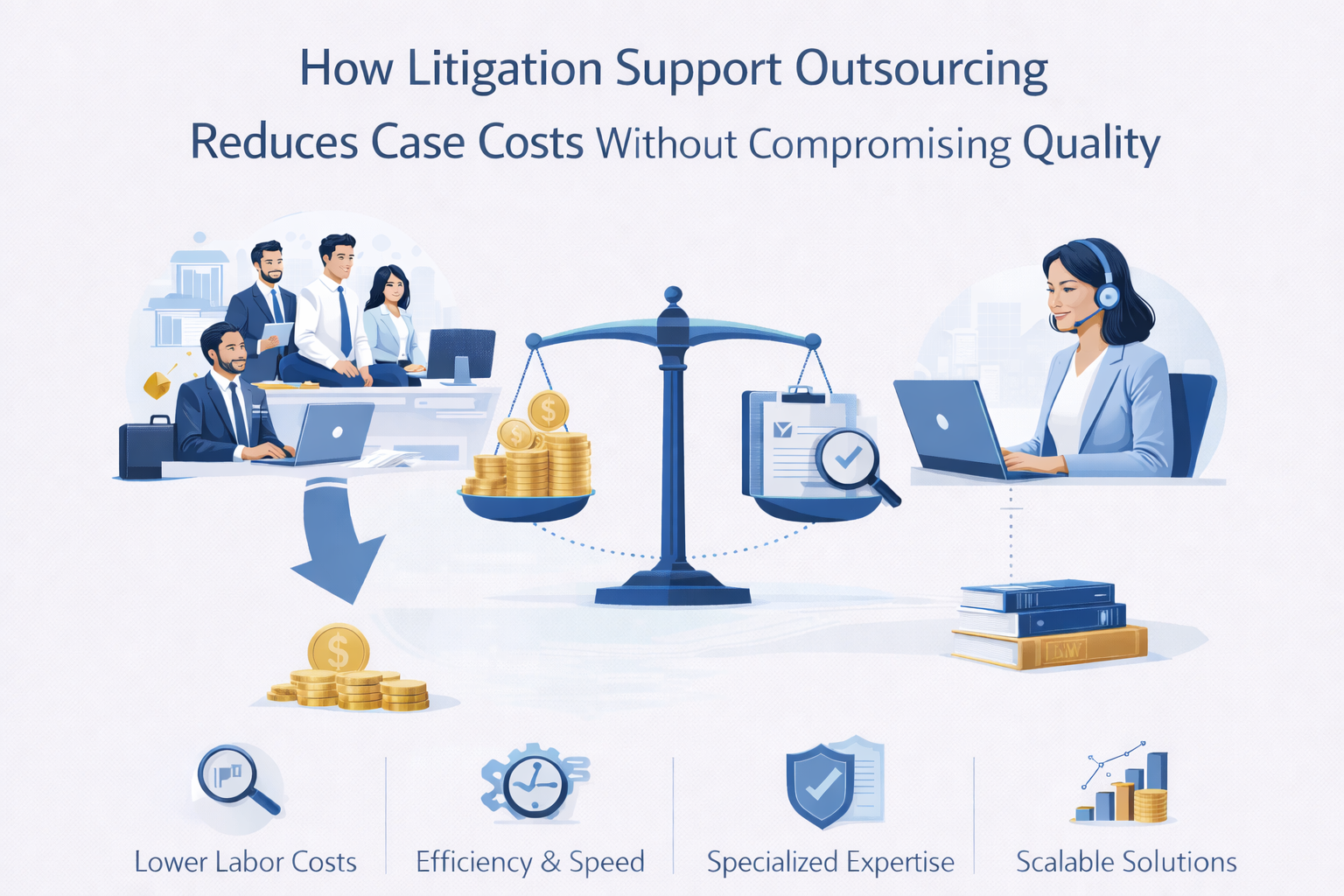
Litigation is expensive. There is no getting around it.
Between attorney fees, expert witnesses, court costs, and discovery expenses, the average commercial litigation case can easily exceed $100,000 and complex matters routinely climb into the millions. For law firms operating on contingency or fixed-fee arrangements, cost management is not just good business practice it’s the difference between profitability and losing money on a case.
Yet many firms continue to approach litigation support the same way they always have: billing attorney and paralegal time for tasks like document review, deposition summaries, exhibit preparation, and legal research work that’s essential but doesn’t require the strategic thinking that justifies premium billing rates.
The math is straightforward but uncomfortable. When associates billing $250-400/hour spend days reviewing discovery documents or summarizing medical records, case costs balloon rapidly. When partners billing $400-600/hour handle routine pleading drafts or timeline preparation, margins evaporate.
There’s a better approach one that reduces litigation costs by 40-60% while maintaining (and often improving) work quality: strategic litigation support outsourcing.
The Cost Structure Problem in Modern Litigation
To understand how outsourcing reduces costs, we first need to acknowledge where litigation expenses actually go.
A typical litigation cost breakdown:
- Discovery and document review: 30-40% of total case costs
- Attorney time (legal research, drafting, strategy): 25-35%
- Depositions and court appearances: 15-20%
- Expert witnesses: 10-15%
- Court costs and filing fees: 5-10%
- Miscellaneous (travel, copies, technology): 5-10%
Notice that discovery and document review the single largest cost category involves work that’s necessary, time-consuming, and detail-oriented, but rarely requires the nuanced legal judgment that distinguishes experienced attorneys from trained support professionals.
The traditional staffing model:
- Partners ($400-600/hour): Case strategy, key depositions, court appearances, client management
- Senior associates ($300-400/hour): Research, drafting, discovery management, witness prep
- Junior associates ($200-300/hour): Document review, pleading preparation, research assistance
- Paralegals ($100-150/hour): Administrative support, filing, scheduling, basic research
Even when firms delegate appropriately, they’re still paying $200-300/hour for document review and summarization work. On a case with 10,000 documents requiring review, that’s $40,000-60,000 in billable time before any substantive legal work begins.
The outsourcing alternative:
Litigation support outsourcing provides access to trained legal professionals paralegals, legal assistants, and document review specialists at $30-75/hour, depending on complexity and expertise required.
Same work. Same quality standards. 60-75% cost reduction.
The savings compound quickly across every aspect of litigation support.
Where Litigation Support Outsourcing Delivers Maximum Impact
Let’s examine the specific litigation support functions where outsourcing provides the greatest cost reduction and efficiency gains.
1. Discovery and Document Review
The challenge: Modern litigation produces massive document volumes emails, contracts, internal communications, financial records, technical documents. Every page requires review for relevance, privilege, and evidentiary value.
Traditional approach: Junior associates and paralegals conduct first-level review at $150-300/hour. On cases with 50,000+ documents, costs easily exceed $100,000.
Outsourcing approach: Specialized document review teams conduct systematic review using established protocols and e-discovery platforms. Associates focus only on complex privilege determinations and key documents.
Cost impact:
- Traditional: 50,000 documents × 2 minutes/document × $250/hour = $104,000
- Outsourced: 50,000 documents × 2 minutes/document × $50/hour = $42,000
- Savings: $62,000 (60% reduction)
Quality advantage: Document review specialists develop expertise through high-volume exposure. They catch details that overwhelmed associates might miss. Systematic protocols ensure consistency across the entire document set.
2. Deposition and Hearing Summaries
The challenge: Depositions and hearings generate hundreds of pages of transcript. Attorneys need concise summaries highlighting key testimony, admissions, and inconsistencies.
Traditional approach: Associates read full transcripts and prepare summaries, billing 3-5 hours per deposition at $250-350/hour.
Outsourcing approach: Legal professionals experienced in deposition summary prepare organized, searchable summaries using page-line citations and topical indexing.
Cost impact:
- Traditional: 20 depositions × 4 hours × $300/hour = $24,000
- Outsourced: 20 depositions × 4 hours × $50/hour = $4,000
- Savings: $20,000 (83% reduction)
Quality advantage: Specialized summarizers develop systematic approaches chronological, topical, or issue-based organization tailored to case needs. Consistent formatting makes cross-referencing efficient.
3. Medical Records Review and Chronology
The challenge: Personal injury, medical malpractice, and workers’ compensation cases involve extensive medical records treatment notes, diagnostic reports, surgical records, billing statements. Attorneys need organized chronologies showing treatment progression.
Traditional approach: Paralegals or associates review records and create chronologies, billing 10-20 hours per plaintiff at $150-300/hour.
Outsourcing approach: Medical records specialists trained in medical terminology prepare detailed chronologies with page citations, organizing information by provider, condition, or treatment type.
Cost impact:
- Traditional: 10 plaintiffs × 15 hours × $200/hour = $30,000
- Outsourced: 10 plaintiffs × 15 hours × $40/hour = $6,000
- Savings: $24,000 (80% reduction)
Quality advantage: Specialists familiar with medical documentation identify relevant details attorneys might overlook. Consistent formatting across multiple plaintiffs enables pattern recognition.
4. Legal Research and Memoranda
The challenge: Every motion, brief, and legal strategy requires case law research, statutory analysis, and jurisdiction-specific precedent review.
Traditional approach: Associates conduct research and draft memoranda at $250-400/hour. Complex research projects consume 10-30 hours.
Outsourcing approach: Legal researchers with access to Westlaw, LexisNexis, and specialized databases conduct targeted research and prepare draft memoranda for attorney review.
Cost impact:
- Traditional: 15 research projects × 12 hours × $300/hour = $54,000
- Outsourced: 15 research projects × 12 hours × $60/hour = $10,800
- Savings: $43,200 (80% reduction)
Quality advantage: Specialized researchers develop deep familiarity with research methodologies and database functionalities. They’re often more efficient than generalist associates who conduct research occasionally.
5. Pleadings and Motion Drafting
The challenge: Standard motions, discovery requests, and responsive pleadings require legal knowledge but follow predictable formats and arguments.
Traditional approach: Associates draft from scratch or heavily modify previous pleadings, billing 5-10 hours per document at $250-350/hour.
Outsourcing approach: Experienced legal drafters prepare initial drafts using jurisdiction-specific templates and case-specific facts. Attorneys review, refine, and finalize.
Cost impact:
- Traditional: 25 pleadings × 7 hours × $300/hour = $52,500
- Outsourced: 25 pleadings × 7 hours × $50/hour = $8,750
- Savings: $43,750 (83% reduction)
Quality advantage: Drafters working exclusively on litigation documents develop template libraries and precedent files. Consistent formatting and argument structure across all filings.
6. Trial Preparation and Exhibit Management
The challenge: Trial preparation involves organizing evidence, preparing exhibit lists, creating trial binders, coordinating witness schedules, and assembling demonstrative aids.
Traditional approach: Associates and paralegals handle trial prep at $150-300/hour. Major trials require 100-200 hours of preparation.
Outsourcing approach: Trial support specialists organize exhibits, prepare indices, create binders, and coordinate logistics under attorney supervision.
Cost impact:
- Traditional: 150 hours × $200/hour = $30,000
- Outsourced: 150 hours × $45/hour = $6,750
- Savings: $23,250 (78% reduction)
Quality advantage: Dedicated trial support professionals develop systematic organization approaches and quality control protocols. Details that overwhelmed teams might miss are caught through checklist-driven processes.
7. Demand Letters and Settlement Packages
The challenge: Personal injury and insurance cases require detailed demand letters supported by medical chronologies, treatment summaries, and damages calculations.
Traditional approach: Attorneys or paralegals draft demand letters and compile supporting documentation at $150-300/hour, spending 8-15 hours per demand.
Outsourcing approach: Legal professionals experienced in personal injury matters prepare comprehensive demand packages using firm templates and case-specific information.
Cost impact:
- Traditional: 40 demands × 10 hours × $200/hour = $80,000
- Outsourced: 40 demands × 10 hours × $40/hour = $16,000
- Savings: $64,000 (80% reduction)
Quality advantage: Specialists working on high volumes of demand letters develop refined approaches to presentation, organization, and persuasive framing often achieving better settlement results.
The Compounding Effect: Case-Level Cost Analysis
To truly appreciate the impact of litigation support outsourcing, let’s examine total case costs across different litigation types.
Example 1: Commercial Litigation Case
Case profile: Contract dispute, moderate discovery (15,000 documents), 12 depositions, summary judgment motion, settlement before trial.
Traditional cost structure:
- Document review: $31,000 (15,000 docs × 2 min × $250/hr)
- Deposition summaries: $14,400 (12 deps × 4 hrs × $300/hr)
- Legal research (5 projects): $18,000 (5 × 12 hrs × $300/hr)
- Pleadings and motions (15 docs): $31,500 (15 × 7 hrs × $300/hr)
- Trial prep (not reached): $0
- Total support costs: $94,900
Outsourced cost structure:
- Document review: $12,500 (15,000 docs × 2 min × $50/hr)
- Deposition summaries: $2,400 (12 deps × 4 hrs × $50/hr)
- Legal research (5 projects): $3,600 (5 × 12 hrs × $60/hr)
- Pleadings and motions (15 docs): $5,250 (15 × 7 hrs × $50/hr)
- Trial prep (not reached): $0
- Total support costs: $23,750
Savings: $71,150 (75% reduction in support costs)
Example 2: Personal Injury Case (Plaintiff)
Case profile: Auto accident, soft tissue injuries, medical records from 5 providers, insurance dispute, settled after demand.
Traditional cost structure:
- Medical records review/chronology: $3,000 (15 hrs × $200/hr)
- Legal research (insurance coverage): $2,400 (8 hrs × $300/hr)
- Demand letter and package: $2,000 (10 hrs × $200/hr)
- Discovery responses: $2,100 (7 hrs × $300/hr)
- Total support costs: $9,500
Outsourced cost structure:
- Medical records review/chronology: $600 (15 hrs × $40/hr)
- Legal research (insurance coverage): $480 (8 hrs × $60/hr)
- Demand letter and package: $400 (10 hrs × $40/hr)
- Discovery responses: $350 (7 hrs × $50/hr)
- Total support costs: $1,830
Savings: $7,670 (81% reduction in support costs)
Example 3: Employment Discrimination Litigation
Case profile: Multi-plaintiff case, extensive email discovery (50,000 documents), 20 depositions, expert testimony, settled during trial.
Traditional cost structure:
- Document review: $104,000 (50,000 docs × 2 min × $250/hr)
- Deposition summaries: $24,000 (20 deps × 4 hrs × $300/hr)
- Legal research (8 projects): $28,800 (8 × 12 hrs × $300/hr)
- Pleadings and motions (20 docs): $42,000 (20 × 7 hrs × $300/hr)
- Trial preparation: $30,000 (150 hrs × $200/hr)
- Total support costs: $228,800
Outsourced cost structure:
- Document review: $42,000 (50,000 docs × 2 min × $50/hr)
- Deposition summaries: $4,000 (20 deps × 4 hrs × $50/hr)
- Legal research (8 projects): $5,760 (8 × 12 hrs × $60/hr)
- Pleadings and motions (20 docs): $7,000 (20 × 7 hrs × $50/hr)
- Trial preparation: $6,750 (150 hrs × $45/hr)
- Total support costs: $65,510
Savings: $163,290 (71% reduction in support costs)
Beyond Direct Cost Savings: The Multiplier Benefits
While hourly rate differences drive the most obvious savings, litigation support outsourcing delivers additional benefits that compound cost advantages:
1. Scalability Without Overhead
Traditional model: Hiring additional associates or paralegals for case surges requires recruitment, training, benefits, and long-term commitments. Letting them go during slow periods is disruptive and expensive.
Outsourcing model: Scale support up or down based on actual caseload. Handle discovery spikes without hiring. Manage seasonal fluctuations without layoffs.
Value: Staffing costs align precisely with revenue. No paying for underutilized capacity during slow periods.
2. 24/7 Productivity Through Global Delivery
Traditional model: Work stops when the office closes. Rush projects require overtime or wait until morning.
Outsourcing model: With global delivery teams, work continues around the clock. Submit document review requests at 5 PM, receive completed work by 8 AM.
Value: Faster turnaround without overtime premiums. Meet tight deadlines without all-nighters.
3. Specialized Expertise Without Training Investment
Traditional model: Training associates on e-discovery platforms, deposition summary techniques, or medical terminology requires time and reduces billable capacity.
Outsourcing model: Access specialists already trained and experienced in specific litigation support functions.
Value: Immediate productivity. No billable hour loss for training. Consistent quality from day one.
4. Technology Access Without Capital Investment
Traditional model: E-discovery platforms, document review tools, and case management systems require licensing fees, IT infrastructure, and maintenance.
Outsourcing model: Many providers include technology access as part of service delivery no separate licensing or infrastructure costs.
Value: Reduce technology overhead while accessing enterprise-grade tools.
5. Improved Attorney Utilization and Satisfaction
Traditional model: Associates spend 40-60% of time on document review, research, and drafting work that doesn’t develop trial skills or client relationships.
Outsourcing model: Associates focus on depositions, motion arguments, client strategy, and courtroom advocacy work that builds careers and justifies premium rates.
Value: Better attorney retention. Higher job satisfaction. More effective skill development.
6. Predictable Budgeting for Fixed-Fee and Contingency Cases
Traditional model: Difficult to estimate support costs accurately. Discovery volume surprises create budget overruns.
Outsourcing model: Transparent, predictable pricing enables accurate case budgeting. Fixed-price options available for defined scopes.
Value: No budget surprises. Better case acceptance decisions based on realistic cost projections.
Addressing Concerns: Quality, Confidentiality, and Control
Despite clear cost advantages, some firms hesitate to outsource litigation support. Let’s address the most common concerns directly.
“Quality will suffer if we outsource”
Reality: Outsourcing providers specializing in litigation support maintain rigorous quality control often exceeding internal standards:
- Trained, experienced legal professionals with subject matter expertise
- Documented procedures and quality assurance protocols
- Multi-level review processes before work product delivery
- Performance metrics and continuous improvement programs
Many firms find outsourced work more consistent than internal production because specialists develop refined methodologies through high-volume exposure.
“Confidentiality and privilege are too risky”
Reality: Reputable litigation support providers implement comprehensive security measures:
- Encrypted data transmission and storage
- Secure access controls and user authentication
- Background checks and confidentiality agreements for all personnel
- Compliance with attorney-client privilege requirements
- Regular security audits and certifications
Often, outsourced systems are more secure than local servers or paper-based processes. Providers understand that confidentiality breaches would destroy their business they have every incentive to maintain stringent security.
“We’ll lose control over case strategy and execution”
Reality: Outsourcing handles execution, not strategy. Attorneys maintain complete control:
- Define review protocols and criteria
- Approve all templates and work product
- Direct research questions and legal arguments
- Review all deliverables before use
- Escalate complex issues immediately
Think of outsourcing as extending your team’s capacity, not replacing your judgment.
“Opposing counsel and clients won’t accept outsourced work”
Reality: Sophisticated clients and opposing counsel care about results, not production methods:
- Corporate clients increasingly require cost-effective litigation management
- Many general counsel actively encourage efficient resource deployment
- Opposing counsel rarely knows (or cares) about your back-office operations
- What matters: accuracy, thoroughness, and timely delivery
Courts have consistently endorsed appropriate outsourcing of litigation support functions, provided attorney supervision and quality control are maintained.
“Communication and coordination will be difficult”
Reality: Modern collaboration tools make remote teams seamless:
- Video conferencing for complex discussions
- Shared document platforms for real-time collaboration
- Project management dashboards for status visibility
- Dedicated points of contact for responsive communication
Many firms find outsourced teams more responsive than overloaded internal staff.
“Our cases are too complex or specialized”
Reality: The best litigation support providers specialize by practice area:
- Personal injury specialists understand medical records and damages calculations
- Intellectual property teams handle technical patents and prior art research
- Employment law experts navigate discrimination and retaliation claims
- Securities litigation specialists manage financial document review
Specialized providers often have more relevant experience than generalist associates.
How to Select the Right Litigation Support Partner
Not all outsourcing providers deliver equal value. When evaluating potential partners, prioritize these critical factors:
Litigation-Specific Expertise
Do they understand litigation workflows, not just general legal work? Look for teams with paralegal certifications, litigation experience, and practice area specialization.
Technology Capabilities
Can they work with your e-discovery platforms (Relativity, Everlaw, Logikcull), case management systems (Clio, MyCase), and document review tools? Native platform compatibility eliminates friction.
Security and Compliance
What protocols protect attorney-client privilege and confidential information? Verify encryption standards, access controls, and compliance certifications (SOC 2, ISO 27001).
Scalability and Flexibility
Can they handle volume spikes without quality degradation? Do they offer multiple engagement models (hourly, project-based, dedicated resources)?
Quality Control Processes
What review procedures ensure accuracy? How do they handle errors or revisions? Look for multi-level review, documented procedures, and performance guarantees.
Communication and Responsiveness
Will you have a dedicated account manager? How quickly do they respond? Time-zone overlap matters for real-time collaboration.
Transparent Pricing
Are costs clear and predictable? Hidden fees and variable pricing create budget uncertainty. The best providers offer straightforward rate cards.
References and Track Record
Do they have verifiable experience with cases similar to yours? Request references from law firms handling comparable litigation.
Getting Started: A Practical Implementation Approach
Transitioning to litigation support outsourcing doesn’t require an all-or-nothing commitment. The most successful firms start small and expand based on results.
Phase 1: Pilot Project (First 30 days)
Start with one clear use case:
- Document review for a single case
- Deposition summaries for upcoming depositions
- Medical chronology for a personal injury matter
- Legal research for a specific motion
Establish success criteria:
- Quality meets or exceeds internal standards
- Turnaround time is faster than internal production
- Cost is 50%+ lower than internal rates
- Communication is responsive and clear
Monitor and measure:
- Track actual costs vs. projected internal costs
- Review work product quality systematically
- Gather attorney feedback on usability
- Document lessons learned
Phase 2: Controlled Expansion (Months 2-3)
If pilot succeeds, expand to additional functions:
- Add more cases of the same type
- Incorporate different support functions
- Test different engagement models (hourly vs. project-based)
Continue measuring performance and refining processes.
Phase 3: Strategic Integration (Months 4-6)
Incorporate outsourcing into standard case management:
- Build outsourcing into case budgets and timelines
- Train attorneys on effective delegation
- Develop streamlined request and review workflows
- Establish ongoing provider relationships
Phase 4: Optimization (Ongoing)
Continuously improve efficiency and value:
- Analyze cost savings and quality metrics
- Refine templates and protocols
- Expand to additional practice areas
- Negotiate volume-based pricing as relationship matures
The Competitive Reality: Adapt or Get Priced Out
Here’s the uncomfortable truth: litigation is becoming more cost-competitive, and clients have more choices than ever.
The market dynamics pushing change:
- Corporate clients demanding cost certainty: More companies require fixed-fee or capped-fee arrangements. Firms that can’t deliver profitably lose business.
- Alternative legal service providers (ALSPs) growing: LegalZoom, Axiom, and other ALSPs offer litigation support at fraction of traditional law firm rates.
- Technology-enabled competitors: Forward-thinking firms leveraging outsourcing can undercut traditional pricing while maintaining quality.
- Client sophistication increasing: General counsel understand litigation economics. They demand efficient resource deployment and question associate-level document review billing.
Firms that continue operating with traditional cost structures will find themselves uncompetitive either losing cases to lower-cost competitors or accepting work at margins that don’t sustain the practice.
The Bottom Line: Strategic Cost Management Enables Better Litigation
Litigation support outsourcing isn’t about cutting corners or compromising quality. It’s about deploying resources intelligently paying appropriate rates for appropriate work.
When document review, deposition summaries, legal research, and pleading preparation are handled by specialized professionals at cost-effective rates, everything changes:
- Case economics improve dramatically: 40-60% reduction in support costs makes more cases financially viable
- Attorney time focuses on high-value work: Strategy, depositions, motion arguments, client relationships
- Scalability becomes possible: Handle volume fluctuations without staffing chaos
- Clients receive better value: Lower costs without quality reduction
- Competitive positioning strengthens: Offer better pricing than firms stuck in traditional models
The question isn’t whether litigation support outsourcing can reduce costs the data is overwhelming. The question is whether your firm will adopt these approaches proactively or be forced to by competitive pressure.
The most successful litigation practices combine in-house attorney expertise for strategy and high-stakes work with outsourced support for systematic execution creating a hybrid model that delivers superior results at sustainable costs.
That’s not the future of litigation. That’s the present and firms embracing it are winning the cases their competitors can’t afford to handle.
Ready to reduce litigation costs without compromising quality?
Connect with FourFold LPO to explore how specialized litigation support outsourcing can transform your case economics while maintaining the standards your clients expect.
Leave a Reply