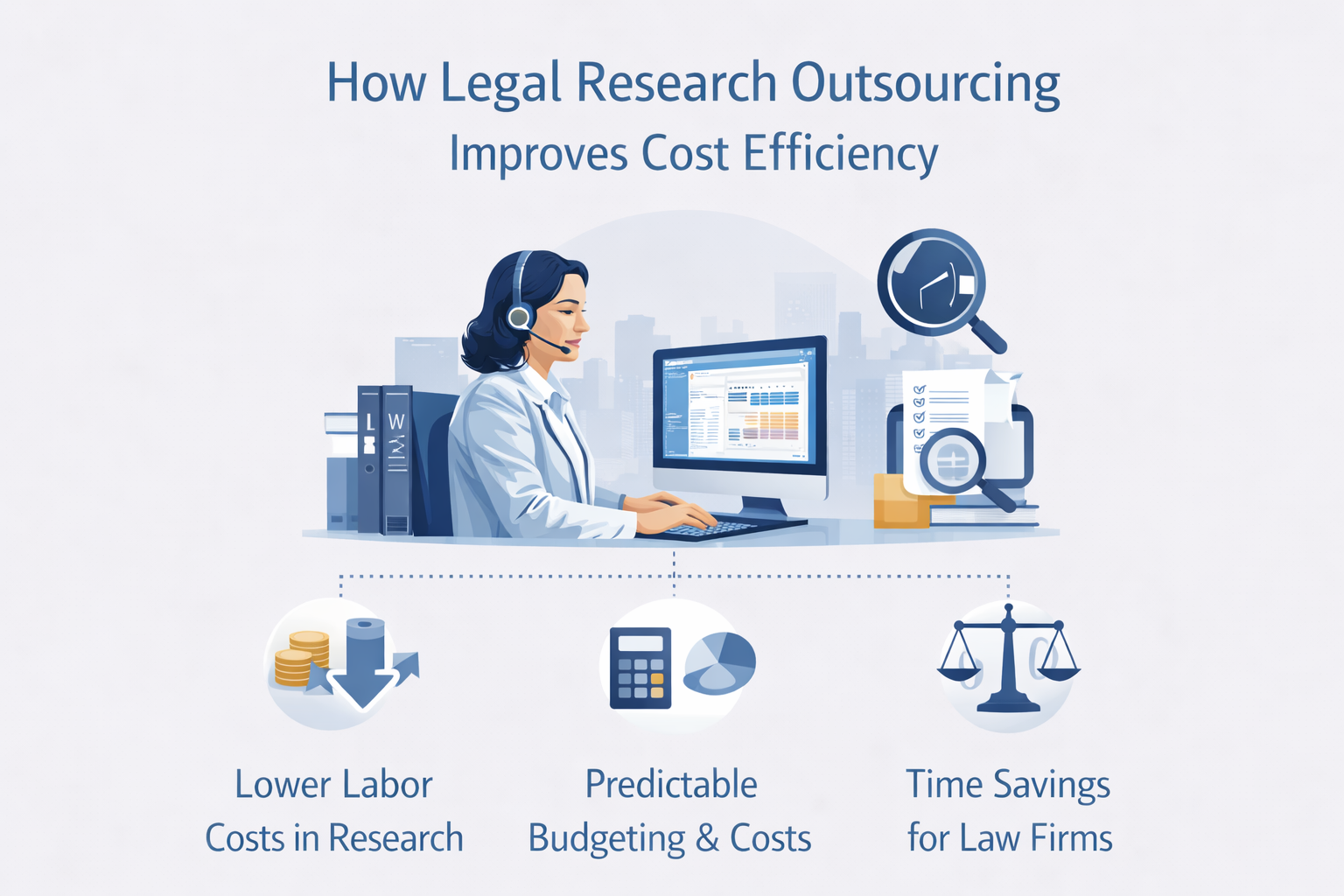
Legal research is the foundation of sound legal strategy, but it’s also one of the most time-intensive and costly aspects of legal practice. Associates and paralegals spend countless hours analyzing case law, interpreting statutes, and preparing memoranda, while clients increasingly push back against high hourly billing rates for research-intensive work.
In this environment, legal research outsourcing has emerged as a strategic solution that allows law firms to maintain research quality while dramatically improving cost efficiency. Here’s how outsourcing legal research delivers measurable financial benefits without compromising the analytical rigor your practice demands.
The True Cost of In-House Legal Research
Before examining the benefits of outsourcing, it’s important to understand the full cost structure of in-house legal research:
Direct Labor Costs: Attorney and paralegal time billed at premium hourly rates, often $150 to $500+ per hour depending on experience level and market.
Opportunity Costs: Every hour spent on research is an hour not spent on client development, courtroom advocacy, negotiations, or other high-value activities that drive firm growth.
Overhead and Infrastructure: Legal research platforms (Westlaw, LexisNexis), office space, benefits, training, and technology infrastructure add 40-60% to base compensation costs.
Inefficiency Costs: Junior attorneys learning on the job, duplicated research efforts, and time spent on jurisdictional matters outside the firm’s core expertise all inflate research costs.
Variable Demand: Staffing for peak research needs means paying for idle capacity during slower periods, while understaffing creates bottlenecks and delays.
When these factors are totaled, the true cost of legal research often exceeds what firms realize, or what clients are willing to pay.
How Outsourcing Reduces Legal Research Costs
Legal research outsourcing transforms a high-cost, variable expense into a predictable, scalable, and significantly more affordable function. Here’s how:
1. Lower Effective Hourly Rates
Outsourced legal research providers employ experienced legal professionals, often attorneys and paralegals with specialized training at rates substantially below traditional in-house costs. Firms typically see 40-60% cost savings compared to having associates or senior paralegals conduct the same research internally.
This differential allows firms to maintain profitability on research-intensive matters while offering more competitive pricing to clients, expanding your ability to take on cases that might otherwise be financially marginal.
2. Elimination of Overhead
When you outsource legal research, you eliminate the overhead burden associated with in-house employees. There are no benefits packages, no office space requirements, no recruitment and training costs, and no ongoing technology subscriptions for additional research platforms.
You pay only for productive research time, not for downtime, administrative tasks, or the fixed costs of maintaining full-time staff.
3. Scalability Without Staffing Risk
Legal research demand fluctuates based on case load, practice area, and litigation phases. Outsourcing provides immediate scalability ramp up research support during discovery, trial preparation, or appellate work, then scale back during slower periods.
This flexibility eliminates the painful choice between understaffing (which creates delays and quality issues) and overstaffing (which wastes resources during slow periods). You access exactly the research capacity you need, when you need, without long-term staffing commitments.
4. Specialized Expertise on Demand
Different cases require different areas of legal expertise. Rather than training generalist staff or hiring specialists for occasional needs, outsourcing gives you access to research professionals with specific experience in personal injury, family law, immigration, intellectual property, criminal defense, commercial litigation, or any other practice area.
This specialization improves both research quality and efficiency—experienced researchers complete projects faster and with greater accuracy, reducing revision cycles and research dead-ends that waste time and money.
5. Time Zone Advantages and Faster Turnaround
Global delivery models enable 24/7 research operations. Submit a research request at the end of your business day and receive comprehensive analysis by the following morning. This accelerated turnaround improves case preparation timelines and allows your attorneys to focus on strategic work rather than spending days buried in case law.
Faster research completion also means faster matter resolution, improved client satisfaction, and better cash flow as cases move through your practice more efficiently.
6. Reduced Billing Write-Offs
One of the hidden costs of in-house research is billing realization, the gap between time worked and time clients will actually pay for. Junior associates may spend 10 hours researching an issue that clients believe should take 3 hours, forcing firms to write off the difference.
Outsourced research eliminates this problem. You purchase research at a known cost, markup appropriately for your market, and present clients with reasonable billing that reflects efficient work product, improving both client relationships and firm profitability.
7. Predictable Cost Structure
Outsourcing converts variable, unpredictable research expenses into manageable, budgetable costs. Whether you engage on a project basis, through blocks of hours, or with dedicated part-time or full-time research support, you gain cost predictability that simplifies financial planning and matter budgeting.
This predictability is especially valuable for fixed-fee arrangements, where research cost overruns can destroy profitability. With outsourcing, you can accurately estimate research costs and price services accordingly.
Cost Efficiency Across Different Engagement Models
Legal research outsourcing accommodates various engagement structures, each offering distinct cost benefits:
Project-Based Research: Pay a fixed fee for defined deliverables ideal for one-off memoranda, case law reviews, or specific legal questions. Eliminates uncertainty and provides clear budget control.
Block of Hours: Pre-purchase hour packages at discounted rates and deploy them as needed. Perfect for firms with regular but variable research needs, providing cost savings while maintaining flexibility.
Part-Time Dedicated Support: Secure consistent research support for a set number of hours weekly at reduced rates compared to full-time in-house staff. Ideal for firms with steady research volume that doesn’t justify full-time hiring.
Full-Time Dedicated Resources: For high-volume practices, dedicated research professionals working exclusively for your firm deliver maximum cost savings while ensuring deep familiarity with your cases, preferences, and standards.
Beyond Cost Savings: The Strategic Value of Outsourcing
While cost efficiency is compelling, legal research outsourcing delivers strategic benefits that extend beyond immediate dollar savings:
Improved Attorney Productivity: Freed from time-consuming research tasks, your attorneys can focus on client relationships, business development, courtroom advocacy, and complex strategy the high-value activities that drive revenue and differentiate your practice.
Enhanced Client Service: Faster research turnaround means faster client communication, quicker case assessments, and more responsive service improving client satisfaction and retention.
Competitive Positioning: Lower research costs enable competitive pricing on research-intensive matters, allowing you to pursue cases or clients that might otherwise be financially unviable.
Quality Consistency: Professional research teams follow systematic methodologies, maintain quality standards, and provide thorough documentation reducing the variability that comes with rotating in-house researchers.
Reduced Training Burden: No need to train new associates on research techniques, familiarize them with unfamiliar jurisdictions, or supervise their work closely. Outsourced researchers arrive with established expertise.
Measuring ROI: What Firms Actually Save
Law firms that implement legal research outsourcing typically realize quantifiable benefits within the first quarter:
- 40-60% reduction in direct research costs compared to in-house attorney or senior paralegal rates
- 20-30% improvement in attorney billable hour capacity as they redirect time toward client-facing work
- 15-25% reduction in billing write-offs on research-intensive matters due to more efficient, defensible billing
- Elimination of overhead costs associated with additional full-time research staff
- Faster case progression resulting in improved cash flow and increased annual matter throughput
For a small to mid-sized firm conducting 500-1,000 research hours annually, these savings can easily total $75,000 to $200,000 per year resources that can be reinvested in business development, technology, or attorney compensation.
Common Concerns About Outsourcing Addressed
“Will quality suffer?”
Professional legal research outsourcing providers employ experienced legal professionals many are licensed attorneys themselves who specialize in research and analysis. Quality often exceeds what generalist in-house staff can deliver, particularly on matters outside the firm’s typical practice areas.
“How do I maintain confidentiality?”
Reputable providers implement rigorous confidentiality protocols, encrypted communications, secure document platforms, and professional standards equivalent to in-house staff. Confidentiality agreements and data protection compliance ensure client information remains protected.
“Will my clients accept outsourced research?”
Clients care about value, quality, and responsiveness not whether research happens in your office or through a trusted partner. In fact, cost-efficient operations allow you to offer better pricing while maintaining service quality, which clients appreciate.
“How do I ensure the research meets my standards?”
Clear communication of expectations, sample work product, and iterative feedback ensure outsourced research aligns with your firm’s standards. Most firms find that after an initial onboarding period outsourced researchers require minimal supervision and consistently deliver quality work.
Getting Started with Legal Research Outsourcing
Implementing legal research outsourcing doesn’t require wholesale practice transformation. Many firms begin with:
- Pilot Projects: Start with a single research memorandum or case law review to evaluate quality, communication, and process.
- Overflow Support: Use outsourcing during peak periods or for matters outside core expertise, maintaining in-house research for routine work.
- Specific Practice Areas: Outsource research for one practice area or case type where demand is consistent but doesn’t justify dedicated staff.
- Gradual Expansion: As comfort and confidence grow, expand outsourcing to additional practice areas and higher volumes.
The key is selecting a provider with demonstrated legal research expertise, strong communication practices, and engagement models that match your needs.
The Bottom Line
Legal research outsourcing isn’t about cutting corners it’s about strategic resource allocation. By accessing specialized expertise at optimized costs, law firms can deliver exceptional research quality while improving profitability, enhancing attorney productivity, and offering competitive value to clients.
In an increasingly competitive legal market where clients demand efficiency and value, outsourcing legal research has become less a luxury and more a strategic necessity for firms committed to sustainable growth and operational excellence.
Ready to improve your firm’s research efficiency and reduce costs? FourFold LPO provides comprehensive legal research and analytical support across all major practice areas from personal injury and family law to intellectual property, immigration, and complex commercial litigation. Our experienced legal professionals deliver jurisdiction-specific memoranda, case law analysis, and statutory interpretation that meets the highest standards of quality and confidentiality. Contact us today to discuss how outsourced legal research can transform your practice’s cost structure and competitive position.
Leave a Reply